British Intelligence
The Spy Who Came in from the ColdBritish Intelligence is the organization whose covert campaign against Hans-Dieter Mundt shapes the novel’s central deception: it makes Alec Leamas appear to betray his Service so that East German investigators will infer that Mundt is a British agent. The plan’s ingenuity lies in making fabricated circumstances look like evidence discovered by the enemy; its moral cost lies in treating agents, allies, and even the truth itself as instruments of institutional survival.
Structure and Strategic Purpose
The operation begins from apparent defeat. After Karl Riemeck’s death, Leamas tells Control that the East German network is gone and that Riemeck was the last agent worth protecting. Control replies that this is not entirely true, but withholds the details. The exchange establishes the organization’s defining condition: even an experienced operative may be denied the information needed to understand his own assignment. Its secrecy is not incidental; it is the mechanism by which the later deception can be staged.
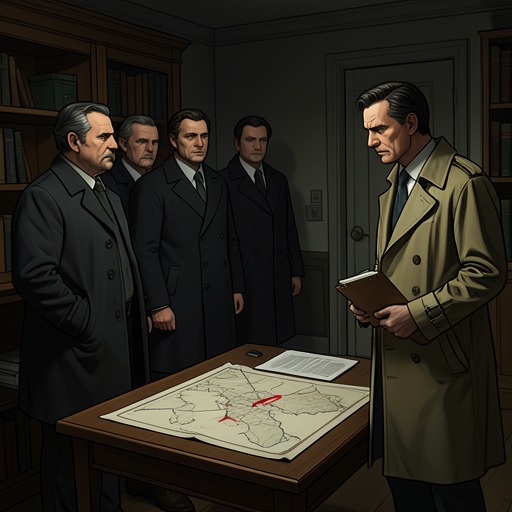
Control identifies Jens Fiedler as the person best placed to act against Mundt. At a dinner with Leamas and Peter Guillam in Control’s Surrey house, he describes Fiedler as Mundt’s subordinate and adversary, a solitary official who hates the Abteilung chief and could match him. Control also emphasizes the antagonism between the two men: Fiedler is Jewish, while Mundt is associated with the opposite political type. British Intelligence intends to give Fiedler a weapon against Mundt, while Leamas’s role is to encourage him to use it indirectly. The plan relies not on issuing Fiedler an instruction but on shaping the information from which he will reach his own conclusion.
The organization’s operational world is suggested through the bureaucratic surroundings in which its rival service works. When Leamas waits with Peters in a house used by the Abteilung, he notices fire instructions, institutional green paint, heavy locks, scratched furniture, and photographs of Soviet leaders. He recognizes in these details the same bureaucratic impulse familiar from the Circus. The parallel makes intelligence work appear less like a contest between radically different worlds than a contest between systems that share habits of secrecy, administration, and control.
Methods: Information, Cover, and Inference
British Intelligence’s campaign is designed to make information do double duty. Leamas’s disclosures about the Berlin organization—its personnel, agents, communications, flats, transport, and photographic and recording equipment—are accurate, but Peters questions whether Riemeck could have obtained the material alone. Leamas later recognizes that both Peters and Control had raised the same question about Riemeck’s access. Their suspicion points toward a protected high-level collaborator and gives the plot’s intelligence problem its shape: the visible facts are real, but their significance depends on what has been concealed around them.
Fiedler identifies the weakness in Leamas’s apparent sale of secrets. The material about Riemeck and the Berlin network, he argues, is accurate but old; it cannot account for the promised fifteen thousand pounds. He insists that the operation is not finished and turns the discussion to Rolling Stone. Leamas explains how an intelligence officer would respond to indications of a spy somewhere within a department: without enough information to identify a suspect, he would wait for more evidence. The maneuver is calculated. The apparently incomplete disclosures become a frame in which Fiedler is invited to infer that a more consequential secret remains to be found.
The financial trail supplies a more concrete pattern. Fiedler tells Leamas that the Copenhagen bank confirmed the withdrawal of the deposited money by his co-signatory exactly one week after the deposit, at a time coinciding with Mundt’s visit to Denmark under an alias. At the Tribunal, Fiedler makes the dates and amount explicit: Leamas opened the Copenhagen account as Robert Lang, deposited ten thousand dollars on June 15, and the co-signatory withdrew the entire sum a week later. Mundt was in Copenhagen on June 21, ostensibly on Abteilung business. Leamas had also made a Helsinki deposit around September 24; on October 3, Mundt made a clandestine journey to Finland. The matching transactions and journeys appear to corroborate Fiedler’s suspicion, while the operation’s design makes that apparent corroboration part of the trap.
The evidence is persuasive because it is assembled to be interpreted, not because any single clue settles the matter. Fiedler revisits the special security arrangements for the file, the letters sent to banks in Copenhagen and Helsinki, and the single reply received. The Helsinki bank supplies no answer; the Copenhagen reply supplies the decisive-looking connection. By organizing dates, aliases, accounts, and travel into a pattern, British Intelligence exploits the very reasoning skills an intelligence officer would use to identify a hidden agent. The operation asks Fiedler to reconstruct a plausible method of payment and then mistake the constructed pattern for independent proof.
The Staged Defection and Its Apparent Evidence
The story Leamas later tells at the Tribunal makes the scheme’s backward construction explicit. Control’s maxim is to set a man to trap himself. Leamas says the planners first asked how they would pay Mundt if he were their agent and what the files would look like; they then worked backward from that imagined procedure. Guillam remembered that an Arab had once offered a breakdown of the Abteilung and that the Service had rejected it, only to discover afterward that the rejection was a mistake. The plan repurposed that episode, making it appear that British Intelligence had rejected the information because it already knew what it contained.
Leamas’s public collapse supplies the human cover. Drinking, money troubles, and rumors that he had robbed the till were made to fit together as signs of professional ruin. Elsie in Accounts and others helped circulate the gossip. On a Saturday morning, with many people about, Leamas staged his breakout; the incident reached the local press and, he thinks, the Worker. The sequence gives the supposed defector a story that can travel beyond the Service without looking like a message planted for the enemy. By the time East German investigators act on it, the performance has become their apparent evidence of his willingness to sell secrets.
The crossing into East Germany is part of the same controlled passage. Leamas can imagine attacking Peters, fleeing the car, and seeking help in Berlin, but does nothing. At the border the vehicles wait for an apparently prearranged moment; a DKW draws attention at the West German checkpoint, and then it and the Mercedes pass through as the barriers rise. Leamas sees the eastern fortifications—dragon’s teeth, observation towers, and double aprons of barbed wire—as the cars proceed. The ease of the crossing does not mean the frontier is harmless: the arrangement is itself evidence that his movement is being managed by people who know when and how to pass.
The danger behind such controlled movement is established earlier by Riemeck’s attempted escape. From a guarded position, Leamas watches Karl reach the Customs hut and come back out, apparently past the document check. The barrier rises, but a sentry remains between him and safety. Searchlights suddenly catch him; an alarm sounds, and the policemen beside Leamas ready their automatic rifles. The East German sentry fires into his own sector. Karl continues on his bicycle for a few moments, then falls as the bicycle clatters to the ground. The episode shows what the operation’s language of assets and access leaves out: crossing a border can turn a person into a target in seconds.
Institutional Secrecy and the Unprotected Agent
The Wall and the division of Berlin are not merely a backdrop to the work of British Intelligence. The author’s account of the Wall describes the first barricades, Embassy evacuation discussions, and American and Soviet Bloc tanks facing one another at Checkpoint Charlie across a hundred-yard strip of road. Intelligence networks had failed to predict the change; agents who remained in place would have to rely on hidden radios and prearranged secret writing. As the border hardened, espionage became more clandestine, perilous, and crowded. The book’s fictional operation takes place in a world where the frontier is both a military confrontation and a system of constraints on what agents can do.
That institutional environment sharpens the difference between knowing a plan and being used by it. Control keeps the protected collaborator’s identity from Leamas, while the plot depends on Leamas appearing to reveal enough information to convince Fiedler. Fiedler, in turn, receives a set of details that invites him to investigate Mundt without being told that the apparent evidence has been designed to lead him there. Each participant works with an incomplete picture; British Intelligence’s advantage is its ability to construct the picture that its adversaries will see.
The organization’s practical reasoning can look like proof even when the underlying evidence is manufactured. Fiedler proposes testing the Copenhagen account by writing to the bank for a statement, using an accommodation address and claiming Leamas is in Switzerland. Leamas notes the risk that Control may already have corresponded with the bank under his forged signature, but Fiedler sees little to lose. The exchange makes the plan’s operational texture concrete: deception is not only a broad political design but a sequence of letters, signatures, accounts, dates, and plausible cover stories.
Exposure and Narrative Significance
At the Tribunal, Fiedler replays the financial and security evidence before a formal audience, treating the correspondence and the travel dates as a case against Mundt. The procedure gives the operation an apparent public test: what began as an engineered suspicion is presented through documentary details and a methodical recapitulation. But the hearing’s outcome reveals that a well-constructed argument is not the same as control over the institution in which it is heard.
Leamas understands the trick only after the Tribunal has declared him under arrest and left action against him to the people’s prosecutor and Mundt. Looking at Mundt’s dispassionate regard for Fiedler, he sees that the operation has not simply placed Mundt under suspicion; it has exposed Fiedler and Leamas to a system in which Mundt can determine what follows. The reversal changes the meaning of British Intelligence’s carefully arranged evidence. Its plan could shape what Fiedler believed, but it could not guarantee that the hearing would protect the man who uncovered the pattern or the agent who had helped create it.
British Intelligence is therefore both a hidden author of events and an institution constrained by its own secrecy. It can recruit, conceal, fabricate, and arrange the terms on which another service interprets evidence; it cannot make the people caught in those arrangements safe. The novel’s sharpest institutional irony is that the elaborate pretense of a defector’s betrayal helps produce a real political danger, while the decisive truth remains inaccessible to the men whose actions depend upon it. Its methods are powerful precisely because they convert people into evidence—and perilous because evidence, once released into another system, no longer belongs to its maker.